
GEO vs SEO: Key Differences, Benefits & What Matters in 2026
GEO vs SEO: Key Differences, Benefits & What Matters in 2026
GEO vs SEO explained: learn how AI search works, how GEO strategies differ from traditional SEO, and how brands can gain visibility in AI-generated answers.
Haritha Kadapa

Highlights
Understanding the shift in search visibility: Generative Engine Optimization (GEO) focuses on ensuring your content is cited and represented in AI‑generated responses, while Search Engine Optimization (SEO) focuses on ranking in traditional search engine results.
SEO still matters: Strong SEO foundations remain important because many AI systems still draw from search indexes, so ranking well on Google and Bing continues to support AI visibility.
GEO Expands your brand’s reach: GEO goes beyond rankings: it manages how your brand is perceived, cited, and trusted across generative AI platforms like ChatGPT, Perplexity, and Google AI Overviews.
AEO complements both: Answer Engine Optimization (AEO) is a tactical layer within GEO that structures content so it can be selected as direct answers in AI results, helping bridge SEO and AI citation goals.
Holistic visibility strategy required: Modern search visibility should combine SEO, GEO, and AEO so brands can maintain presence in traditional search, AI summaries, and conversational AI responses.
GEO vs SEO: Understanding this difference is now essential for brands that want to remain visible and relevant in the era of AI search. Approximately 60% of users now end their Google searches without clicking on any results. This shift reflects how people are changing the way they find information. If your content isn't optimized for AI systems, your brand may disappear from the decision-making process entirely.
Search Engine Optimization (SEO) helps your website rank on traditional search engines. Generative Engine Optimization (GEO) manages your brand’s broader presence across the entire AI search, how you are perceived, cited, and represented. Additionally, a third discipline, Answer Engine Optimization (AEO), has emerged! AEO ensures that your content is selected as the direct answer in AI-generated responses. These are not competing tactics. They are the distinct layers of visibility that operate across different platforms.
This guide explains how AI search works. It covers the differences between SEO, GEO, and AEO and where they overlap. Further, this guide includes strategies for enhancing AI visibility and for measuring performance in AI-driven search environments.
GEO vs. SEO: Understanding the differences
When discussing online content optimization, you should distinguish between Generative Engine Optimization (GEO) and Traditional Search Engine Optimization (SEO).
Traditional SEO focuses on improving website rankings in search engines such as Google and Bing. The goal is to increase visibility and drive traffic to a website by improving search ranking.
GEO aims to ensure that your content is cited or referenced in AI-generated answers produced by large language models. These models are utilized by platforms like ChatGPT, Perplexity, and Google AI Overviews.
When users pose a question or prompt, these AI systems generate synthesized answers. Their responses summarize information. This is different from the traditional method of simply listing website links.
If your content lacks recognition as a reliable source, it may not feature in AI-generated responses.
Why is SEO still relevant in AI search?
AI search is transforming how users discover information. Instead of browsing multiple websites, users now receive summarized answers almost instantly.
Recent research underscores the scale of this shift:
OpenAI reports that over 700 million users interact with ChatGPT each week.
Semrush data reveals that Google AI Overviews appear in approximately 18–25% of informational searches.
Gartner predicts that traditional search engine volume will decrease by 25% by 2026.
Users are increasingly interacting with AI assistants as their primary touchpoint in research journeys. Users conduct research on products, services, and vendors within AI interfaces, often without visiting websites until later in the decision-making process. This behavior has led marketers to refer to it as the “Invisible Funnel.”
However, SEO remains essential. SEO originally focused on optimizing web content to rank in traditional search engine results pages (SERPs). The main factors include keywords, backlinks, technical structure, and on-page content quality. When someone searches on Google and clicks on a link, SEO determines whether your page appears.
SEO is still crucial in AI search for several reasons. AI platforms do not operate in isolation. For example, ChatGPT uses Google's search index via SerpAPI, Perplexity has its own web crawler, and Google AI Overviews rely on Google's search index. Strong organic rankings continue to enhance visibility in AI. Therefore, abandoning SEO in favor of AI search would be a strategic mistake.
What is AEO, and how does it relate to Google AI overviews?
AEO, or Answer Engine Optimization, is the practice of structuring and formatting content so that it appears in direct answer boxes and Google AI Overviews. While SEO focuses on ranked links, AEO targets the answer itself.
When someone asks Google a question and an AI Overview appear at the top of the page, providing an answer before any blue links, this is considered an AEO domain. AEO is more specialized and concentrates on the answer layer. Content is structured for AI overviews to select, reproduce accurately, and attribute as needed. Think of AEO as the tactical discipline within the broader strategic framework represented by GEO.
3.1 What AEO optimizes for
Schema markup and structured data
Concise, extractable definitions for featured snippets
Direct question-and-answer formatting for FAQ content
How does GEO differ from SEO and AEO?
GEO (Generative Engine Optimization) is the strategic and operational discipline involved in managing your brand's presence across AI search platforms. The primary objective is to ensure that a brand appears in AI-generated responses. The brand must also be presented positively across different touchpoints and sources.
SEO (Search Engine Optimization) focuses on optimizing a website’s visibility in traditional search engine results. In contrast, GEO is an extension of SEO, broadening its focus into AI.
AEO (Answer Engine Optimization) serves as a tactical layer focusing on how individual pieces of content are selected and cited. GEO, however, functions as a comprehensive framework. It encompasses your owned content, third-party mentions, digital public relations, and the management of entity reputation.
AEO is a component within the broader discipline of GEO. While GEO incorporates all strategies for optimizing content across generative AI platforms, AEO specifically addresses the answer-retrieval layer.
4.1 What GEO manages
Brand presence across large language models (LLMs)
AI citation tracking in platforms like ChatGPT, Perplexity, and Google AI Overviews
Accurate sentiment analysis in AI-generated summaries
Share of voice in AI responses
The “invisible funnel” is the purchase decisions influenced by AI responses, which do not appear in your analytics
Table 1: The difference between SEO, AEO and GEO.
Category | SEO Search Engine Optimization | AEO Answer Engine Optimization | GEO Generative Engine Optimization |
Definition | Focuses on improving website rankings in traditional search engine results | Focuses on structuring content so it appears as a direct answer in AI-powered search interfaces | Focuses on ensuring a brand is cited or referenced inside AI responses |
Primary goal | Rank in traditional search results and drive organic website traffic | Become the direct answer source for user questions in AI search | Maintain strong brand visibility across the AI platforms |
Discovery method | Search engine ranking pages (SERPs) | Direct answer boxes, featured snippets, and AI summaries | AI responses created by large language models |
Output format | List of website links | Direct answers and structured summaries | Synthesised AI responses referencing multiple sources |
User journey | Users click multiple search results before finding information | Users receive an immediate answer with optional source links | Users receive a full AI-generated explanation in one response |
Optimization focus | Keywords, backlinks, technical SEO, and search intent | Structured answers, schema markup, and concise definitions | Structured knowledge, entity authority, and citation-ready explanations |
Key platforms | Google, Bing | Google AI Overviews, Perplexity, ChatGPT, Bing Copilot | ChatGPT, Perplexity, Google AI Overviews, other LLM-based AI systems |
Success metrics | Rankings, organic traffic, click-through rate, backlinks | Answer citations, featured answer placements, schema eligibility | Brand mentions frequency, citation accuracy, AI share of voice |
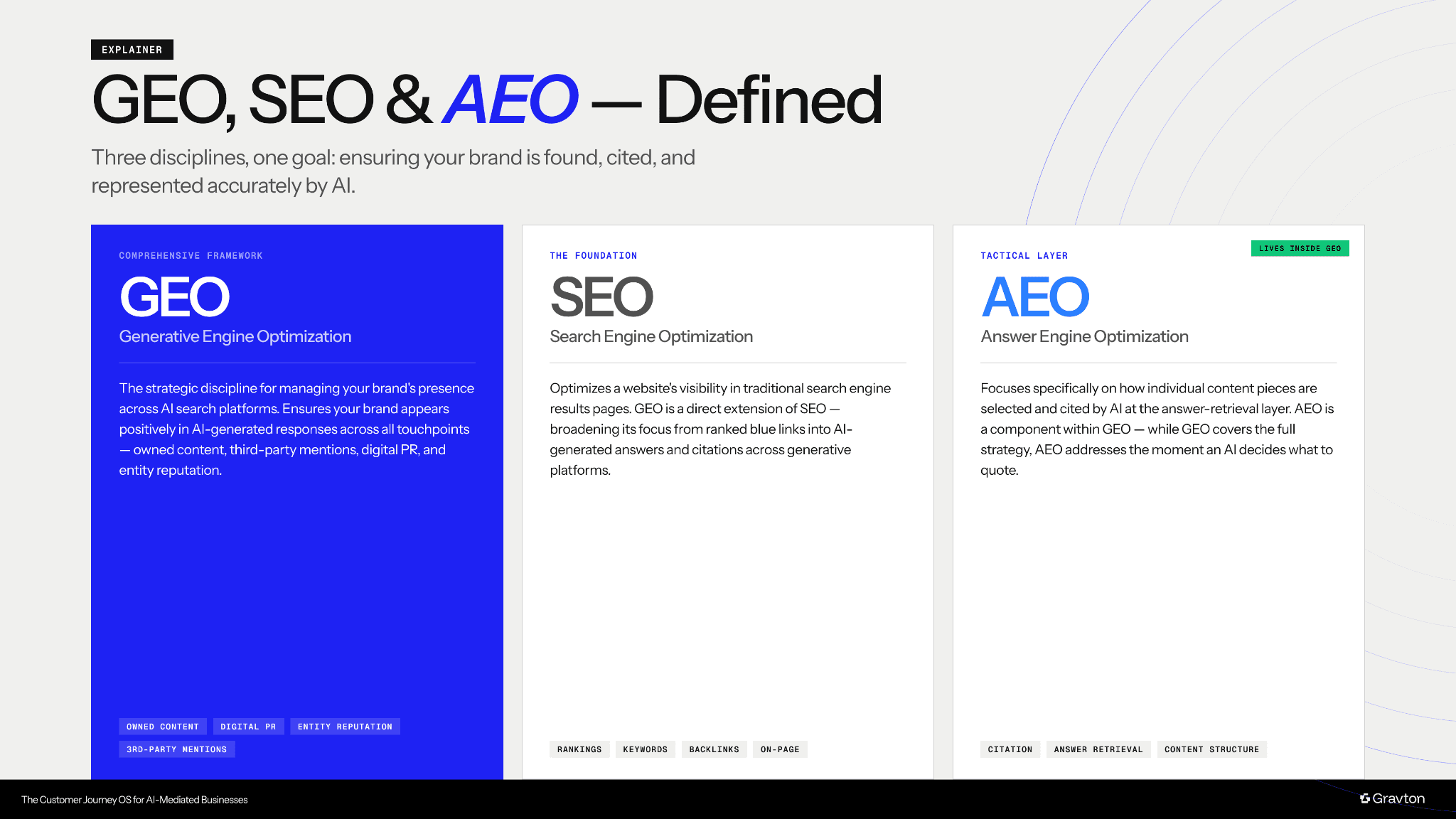
Figure 1: Three disciplines of search optimization: GEO, SEO, and AEO.
What are the core GEO best practices?
GEO, or Generative Engine Optimization ensures that large language models (LLMs) cite your content when generating answers. It focuses on:
Factual clarity
Entity recognition
Structured explanations
Authoritative sources
|
To succeed in AI search, content must be crafted in a manner that AI platforms can easily interpret and cite. Several best practices have emerged from early GEO experiments:
Step 1: Define concepts clearly
Structured and clearly formatted content is more likely to be cited by generative AI models. AI models prefer content with clear definitions. For example, “Generative Engine Optimization is the process of optimizing content, so it appears in AI-generated answers from large language models.”
Step 2: Use structured knowledge
Providing organized information increases the likelihood of being cited. Use headings, definitions, lists, and comparison tables to present your content.
Step 3: Lead every section with a direct answer
AI engines extract the first one to two sentences of a section to determine if it answers a user query. If your opening is vague or merely sets the context, the engine will likely move on.
Step 4: Build topical authority
In AI search results, the top 10 domains capture about half of all citations, showing how strongly AI engines favor authoritative sources. AI systems evaluate a site’s depth and credibility across a topic area, not just individual pages or keywords. A cluster of well-linked, expert-level content on a subject signals' authority to LLMs when they decide what to cite.
Step 5: Publish authoritative explanations
Regularly mention relevant entities to help models understand their relationships. AI systems identify entities such as companies, products, technologies, and Subject Matter Experts (SMEs). Expert sources and structured guides get more citations than shorter blog posts. In addition, content citing five or more authoritative sources receives more AI citations.
Step 6: Earn credible third-party mentions
AI platforms gather information from a wide range of sources online. Third-party platforms like Reddit now account for about 21% of AI Overview citations. Mentions in industry publications, expert roundups, and other credible external sources enhance how AI models perceive and represent your brand. Digital PR is a significant factor in this.
Step 7: Use schema markup
Schema markup reduces ambiguity for both crawlers and AI systems. Implementing the FAQ schema, the How-To schema, and the Organization schema helps platforms accurately extract and attribute your content.
Step 8: Update content regularly
Leading brands in GEO update their content quarterly. Freshness is a crucial ranking signal for AI search.
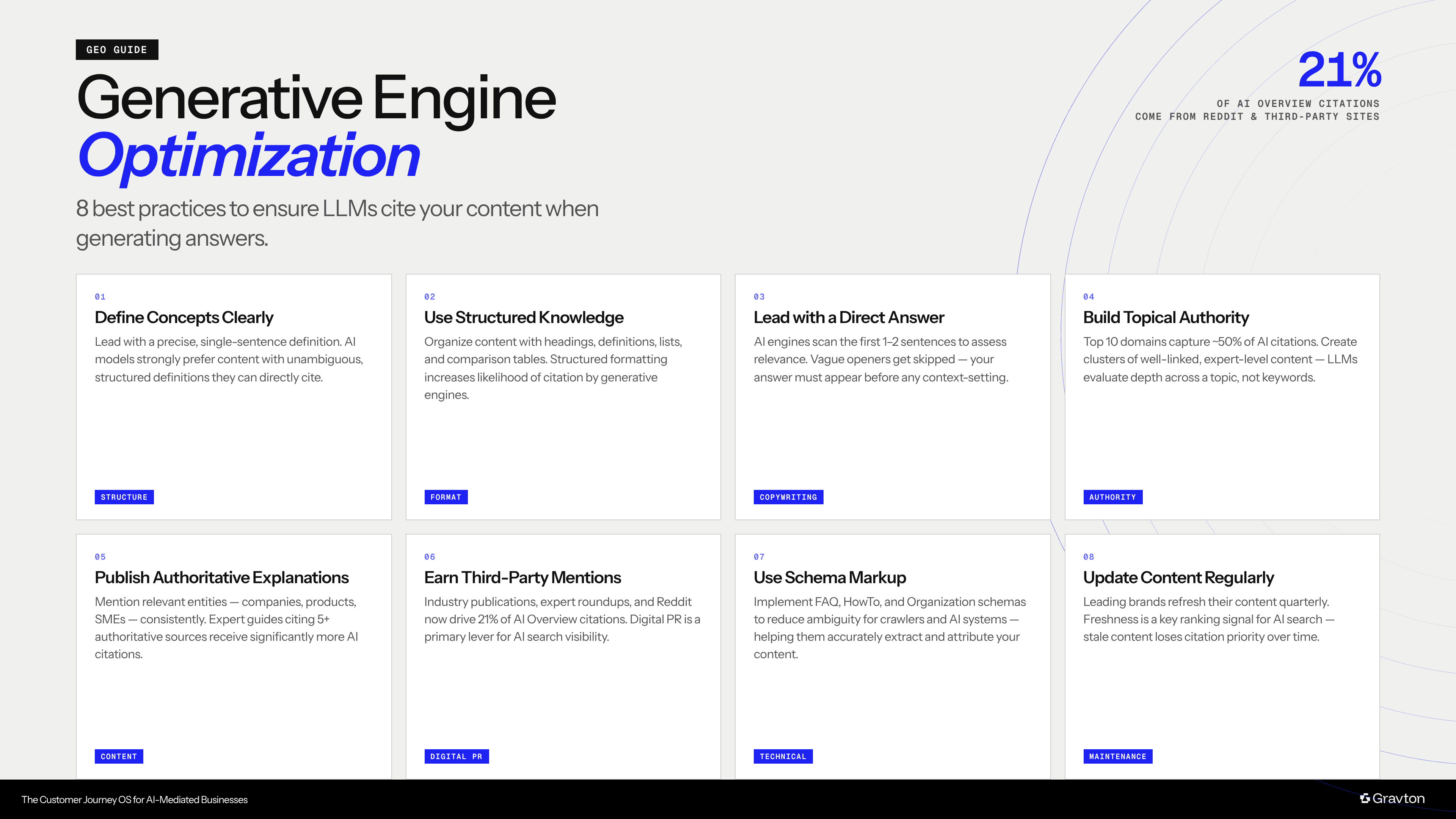
Figure 2: Core GEO best practices.
The future of search: GEO, SEO, and AEO must work together
The question of GEO vs SEO has a clear answer: you need both, along with AEO. SEO helps maintain your presence in traditional search engines and supports the crawlers that AI platforms rely on. AEO ensures your content is structured so it can be selected and cited in AI-generated answers. GEO manages the full scope of how your brand is represented, discovered, and trusted across every AI platform your buyers use.
Brands that optimize for AI visibility, structured knowledge, and citation-friendly content will gain a significant advantage as AI search adoption continues to grow. These are the brands that recognize AI visibility as an emerging challenge.
The invisible funnel is active now. The measurement gap is real. A modern search visibility strategy should not be about SEO or GEO alone. It includes SEO, AEO, and GEO, all functioning as a single, coordinated program.
GEO vs SEO: FAQs
What is Generative Engine Optimization (GEO)?
Generative Engine Optimization (GEO) is the practice of optimizing digital content so that AI platforms, including ChatGPT, Perplexity, Google AI Overviews, and Gemini etc., can discover, understand, and cite it in their generated responses. It focuses on content clarity, authority, and structure rather than keyword rankings.
What is Answer Engine Optimisation?
Answer Engine Optimisation (AEO) is the process of structuring and formatting content so it can be selected as a direct answer in AI-powered search experiences such as Google AI Overviews, featured snippets, and conversational assistants. While traditional SEO optimises pages to rank in search results, AEO focuses on the answer layer itself. It prioritises concise definitions, question-and-answer formatting, and structured data, such as schema markup, to make content easier for AI systems to extract and reproduce.
How does AEO relate to GEO?
Answer Engine Optimisation (AEO) is a tactical component of Generative Engine Optimisation (GEO). While GEO manages the full scope of a brand’s visibility across AI platforms, AEO focuses specifically on the answer-retrieval layer. It involves optimising how individual pieces of content are structured so they can be easily retrieved, quoted, and accurately summarised by AI systems when generating responses.
How does GEO differ from SEO?
SEO, or Search Engine Optimisation, focuses on ranking in traditional search engine results pages to earn clicks. GEO (Generative Engine Optimisation) is the broader discipline of managing your brand's presence and accuracy across AI-powered platforms like ChatGPT, Perplexity, and Google AI Overviews.
Do I need to choose between SEO, GEO, and AEO?
No. All the disciplines complement each other. SEO drives traffic to your site. AEO builds visibility in conversational and zero-click experiences. GEO manages the full AI visibility picture. A mature strategy runs all three in parallel.
Why does the GEO vs SEO strategy matter for my business now?
Studies reveal that 60% of Google searches end without a click. Google AI Overviews appear in approximately 18–25% of informational searches. If your brand is not visible in AI-generated answers, it may not appear in the research phase of the Invisible Funnel.
What is the invisible funnel in the context of GEO?
The invisible funnel refers to the segment of the buyer journey that takes place within AI platforms. For instance, a potential customer might ask ChatGPT for category recommendations, read an AI-generated comparison, and develop brand preferences based on these interactions. These conversations significantly influence purchasing decisions, yet they often go untracked in your analytics. GEO aims to enhance your brand's visibility and accuracy within this invisible funnel.
How can companies implement GEO best practices?
Companies can improve GEO performance by clearly defining concepts, structuring content with headings and lists, publishing authoritative explanations, and building strong entity signals.
Win your AI search demand universe
Understand how AI platforms differ from traditional search engines in how they surface brands and where competitors are gaining ground beyond your SEO strategy.
VISIBILITY & CONTENT STRATEGY