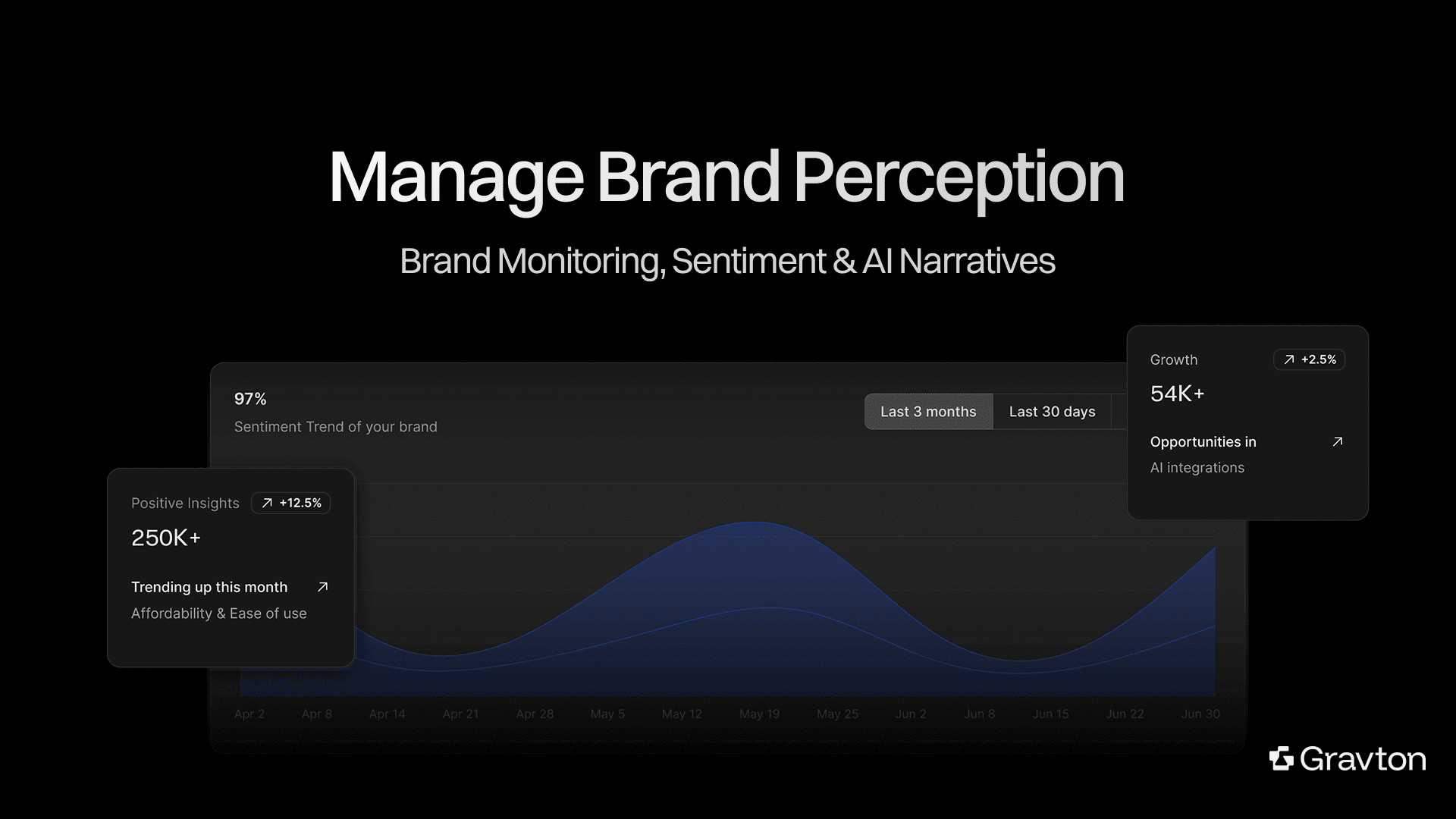
Brand Monitoring, Sentiment & AI Narratives
Learn how Brand Monitoring, Sentiment & AI Narratives shape AI search results and how to manage brand perception across generative AI platforms.
Haritha Kadapa
Highlights
AI Narratives Now Shape First Impressions: AI platforms increasingly form a brand’s first interaction with potential customers by delivering direct, synthesized answers instead of traditional search results.
Brand Perception Operates Across Three Layers: Modern reputation management requires tracking raw mentions, sentiment, and AI-generated narratives to understand how both people and machines interpret your brand.
AI Systems Construct Narratives from Multiple Signals: Large language models combine credibility, citation frequency, topical authority, and freshness to generate brand descriptions, which means omission or outdated content can distort positioning.
AI Monitoring Expands Beyond Traditional Brand Monitoring: While traditional tools track what people say, AI monitoring reveals how machines summarize and present that information, introducing new risks such as narrative distortion and invisibility.
Proactive GEO and Continuous Auditing Are Now Essential: Companies need to audit AI responses, publish structured and authoritative content, and track AI-specific metrics to maintain accurate representation and competitive visibility in AI-driven discovery.
The transition from traditional search engines to AI platforms has made Brand Monitoring, Sentiment Analysis, and AI Narratives essential functions in modern marketing. AI-driven discovery tools are transforming brand reputation and the way consumers learn about brands. The key question now isn’t whether your company is receiving mentions, but rather what AI is saying about you.
For brands, it is crucial to track and understand the influence of AI engines and large language models (LLMs) on their reputation. This guide explains what Brand Monitoring, Sentiment, and AI Narratives are, why they are important today, and how companies can effectively monitor and manage their AI reputation monitoring.
|
What Brand Monitoring, Sentiment, and AI Narratives Mean Today
Brand monitoring involves actively tracking where and how people mention your brand across digital channels. Traditionally, monitoring focused on social media listening tools, news aggregators, and review site alerts. These tools remain useful today, but they capture only a fraction of what shapes modern buyer perception.
In the AI era, brand perception is influenced not only by what people say, but also by how AI models interpret and summarize that information. As a result, companies now need to monitor three complementary layers of brand perception: brand monitoring, sentiment analysis, and AI narrative tracking.
Monitoring tells you what is said.
Sentiment tells you how it is said.
AI narratives tell you what meaning AI assigns to it.
These practices enable companies to understand brand mentions in AI search, how it is perceived, and summarized across both human and AI platforms.
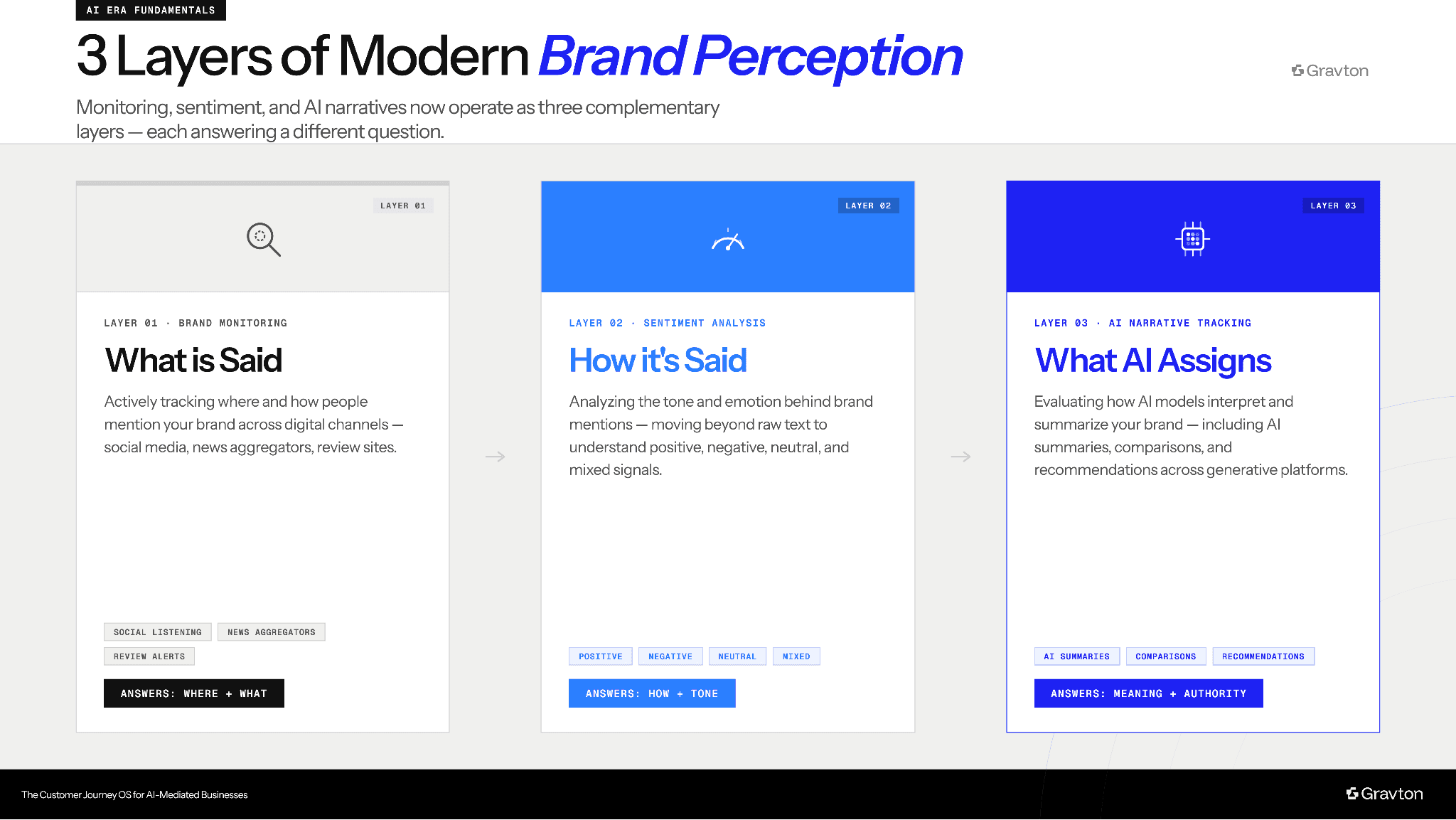
Figure 1: Three layers of modern brand perception: Brand monitoring, sentiment analysis, and narrative tracking.
AI brand sentiment monitoring extends classic sentiment analysis into generative environments. Instead of analyzing only raw text, brands now need to evaluate:
AI summaries
AI comparisons
AI recommendations
For example, when a potential customer asks ChatGPT, “What’s the best project management software for mid-sized teams?” or asks Perplexity, “Is Your Brand trustworthy?”, they provide a synthesized response. Assume that response describes your company as “a niche provider” instead of “an industry leader.” The difference reveals narrative drift, a measurable gap between real-world positioning and AI narrative.
Each generated answer carries implicit sentiment, positive, negative, neutral, or even absent. The AI's responses have the authority of a trusted assistant, significantly enhancing their influence on buyer perception compared to traditional search results.
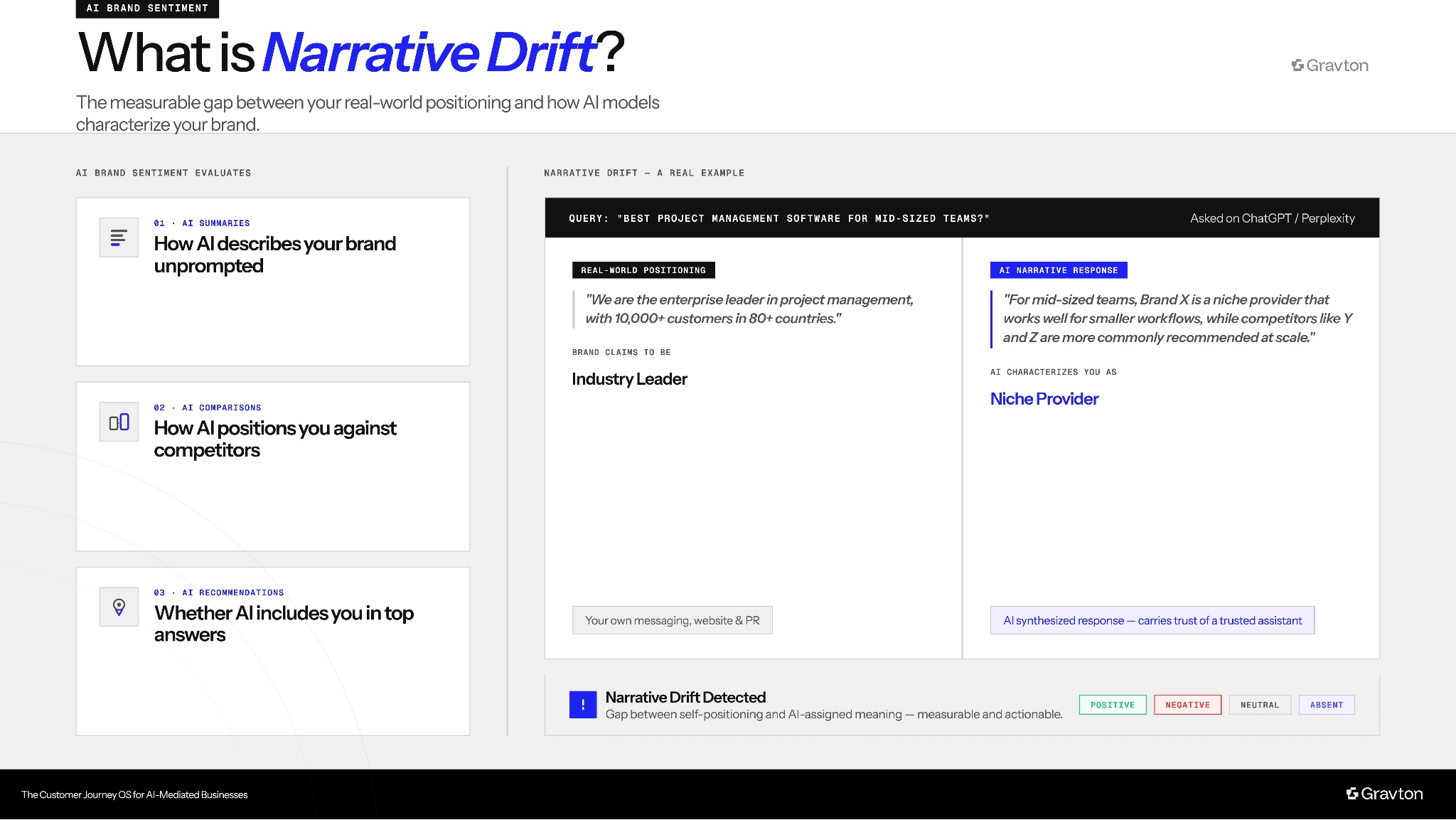
Figure 2: Narrative draft
Why AI Narratives Now Shape Brand Reputation and Buyer Decisions
AI narratives influence how users understand a brand.
Characteristics that make AI narratives particularly powerful
Authority by default
Users tend to treat AI responses as curated, vetted summaries. They assume that someone has reviewed and verified AI responses for correctness and quality before presenting them. As a result, users often perceive AI narratives as more credible than traditional search results filled with blue links.
Invisible sourcing
Most users do not scrutinize the sources behind an AI narrative. If the model draws from outdated, biased, or negatively framed content, users absorb that perspective without questioning it.
In addition, this shift from traditional search to AI platforms has introduced a new layer in the buyer journey, often called the Invisible Funnel.
In this invisible funnel:
Discovery occurs inside AI chat interfaces.
Evaluation happens through AI-generated comparisons and summaries.
Only a portion of users click through to a company’s website.
Recent industry reports highlight how quickly AI adoption is scaling
~65% of digital consumers now use AI platforms to research brands before visiting a website.
Specifically, 35% of customers use generative AI for shopping and research.
Search engine query volume is projected to drop by 25% as AI chatbots and virtual agents handle more informational queries.
By 2026, experts expect 70% of enterprise recommendations to originate from AI platforms.
The above reports highlight that AI-generated answers now create the first impression of a company. If AI platforms synthesize inaccurate, outdated, or negatively framed information, they affect user decisions.
How AI Systems Construct Brand Sentiment and Narratives
LLMs learn associations between brand names and descriptive language across the web. Over time, they build statistical relationships between a brand and the terms that frequently appear alongside it.
Because of this, AI brand sentiment relies on multiple selection signals instead of just one. These signals include:
Domain credibility / Reputation & Trust
Citation frequency
Topical authority
Consensus and mentions
Structure and formatting
Prompt matching / Semantic relevance
Freshness
Platform model factors
To understand how these signals shape brand narratives, it is essential to grasp how LLMs develop citation awareness. This process typically unfolds in two stages:
Training phase: Models ingest massive text corpora and learn general associations between brands and descriptors.
Retrieval phase: During generation, models actively retrieve sources that appear credible, relevant, and consistent, effectively conducting a real-time.
In this context, absence also serves as a signal. If a model omits your brand, that omission can imply negative brand sentiment.
How AI Monitoring Differs from Traditional Brand Monitoring
Traditional brand monitoring focuses on tracking mentions across social platforms, news outlets, and review sites. AI monitoring extends this concept by tracking how AI systems synthesize and present those mentions.
Traditional monitoring tells you what people say. AI monitoring tells you what machines conclude.
Table 1: Key differences between traditional brand monitoring and AI monitoring.
Feature | Traditional Monitoring | AI Monitoring |
Data sources | Social, news, reviews | AI summaries, citations, LLM output |
Output format | Raw mentions | Synthesized narratives |
Risk type | Reputation damage | Narrative distortion or omissions |
Response speed | Reactive | Requires proactive content strategy |
Measurement | Volume and sentiment | Visibility and citation frequency |
How to Audit and Monitor Your Brand’s AI Narrative
An AI narrative audit is a periodic assessment that captures how AI systems currently describe your brand.
5 steps to audit AI Brand Narrative
Step 1: Define your core query set
List queries or prompts your buyers might use when researching your category. Include branded queries (Ex: "What is Your Brand?"), category queries (Ex: "Best category tools for enterprise"), and competitor-comparative queries (Ex: "How does Your Brand compare to Competitor?").
Step 2: Run queries across platforms
Test your queries in ChatGPT, Perplexity, Google AI Overviews, Microsoft Copilot, and Claude. Document not just whether your brand appears, but also the responses.
Step 3: Classify sentiment and positioning
For each response, determine the sentiment conveyed: positive, neutral, negative, or mixed? Assess whether your brand positions itself as a leader, an alternative, or remains absent entirely.
Step 4: Identify the source pattern
When your brand is mentioned, trace which sources (such as your website content, social media, etc.) the AI platforms draw upon. Identifying these sources reveals which content assets have AI visibility and which are being overlooked.
Step 5: Benchmark against competitors
Run the same queries, substituting in competitor brands. Understand the gaps between how AI characterizes your brand versus how it characterizes your competitors.
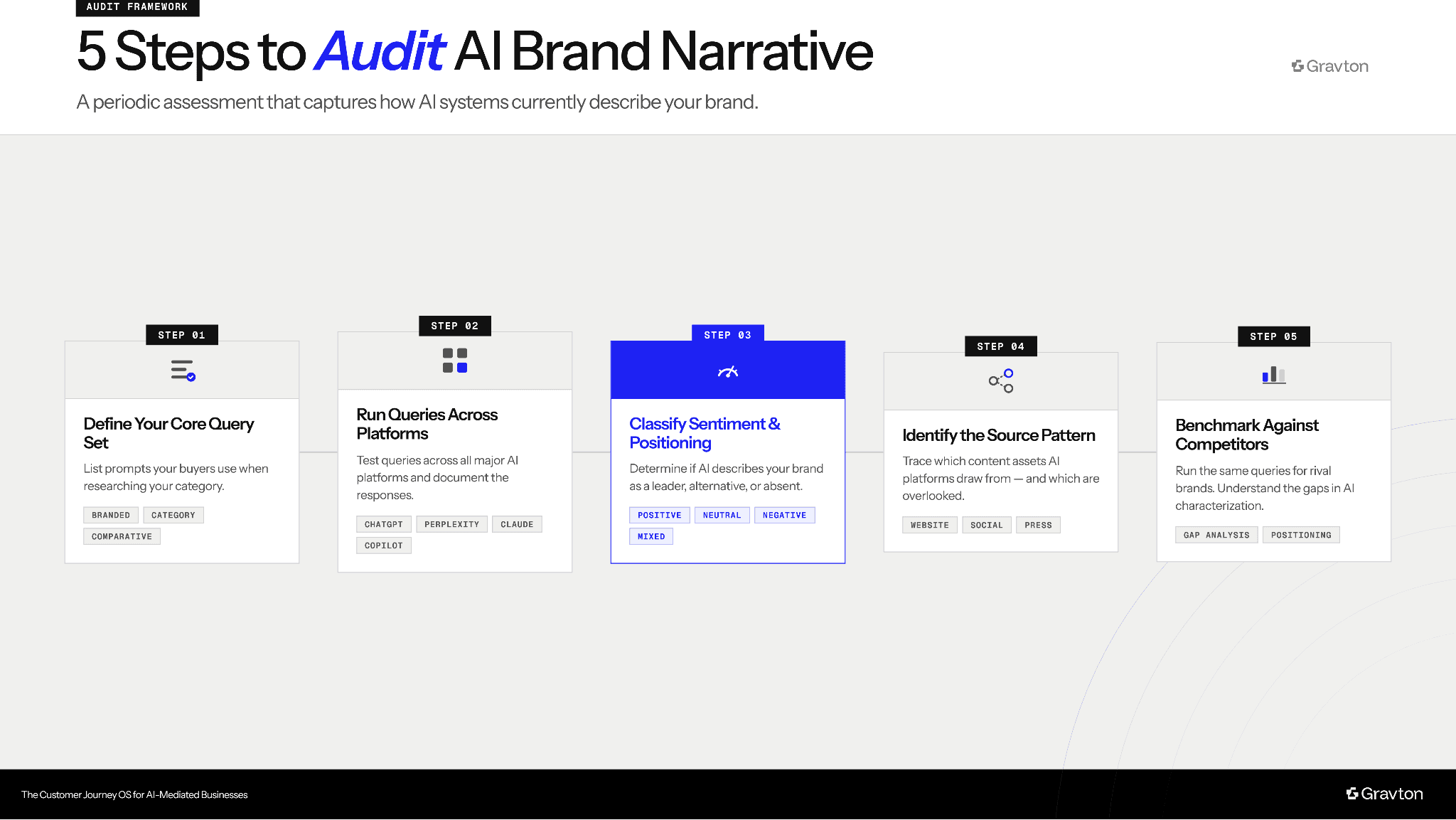
Figure 3: Five steps to audit AI brand narrative.
How Brands Can Influence AI Narratives
Achieving narrative control in AI results does not require direct access to AI models. Brands cannot directly edit AI models, but they can influence the data that LLMs use.
To control your brand narrative in AI search,
Focus on building trust and strategic precision in your digital footprint.
Focus on making content easy for AI systems to understand, trust, and cite by emphasizing clear definitions, structured formatting, topical authority, and credible external validation.
Present factual, well-organized, and consistently reinforce knowledge across the entire digital presence.
These practices align with Generative Engine Optimization (GEO) - best practices, which aim to increase the likelihood that your content appears in AI responses.
How to Measure AI Narrative Performance
Effective AI reputation monitoring requires measurement frameworks that go beyond traditional social listening metrics. The following indicators provide a practical measurement framework:
Table 2: Key metrics for measuring AI narrative performance.
Metric | What It Measures |
AI mention rate | Percentage of relevant queries where your brand appears |
Sentiment distribution | Ratio of positive, neutral, and negative AI descriptions |
Share of AI voice | Your brand’s presence relative to competitors |
Citation quality | Authority of sources AI uses when referencing your brand |
Absence rate | Percentage of queries where your brand is omitted |
Tracking these metrics over time helps companies identify narrative drift and evaluate whether content optimization efforts are improving AI visibility and sentiment.
AI Narrative Risk and Recovery
Companies often find that AI narratives persist even after they resolve underlying issues. For example, if a company faced a security incident several years ago, older articles may continue to label it as risky, even though it is no longer considered risky.
To counter this, companies need to publish updated security documentation and clearly document their remediation steps in authoritative sources. Over time, these newer signals can replace outdated narratives in AI responses.
|
Final Thoughts: Your Brand's Reputation Lives in AI Results Now
Brand monitoring, sentiment analysis, and AI narrative tracking now form a single, essential discipline. AI platforms often shape a brand's first impression. They not only reflect public opinion; they summarize and present it as authoritative answers that shape buyer perception.
Companies need to monitor how AI systems interpret, rank, and describe their brand. They should start AI narrative audits and regular monitoring across major AI platforms. The use of Generative Engine Optimization (GEO) practices ensures that accurate and authoritative content becomes the primary source for AI responses.
Companies should track metrics such as AI mention rate, sentiment distribution, share of AI voice, and citation quality. These indicators help detect narrative drift.
AI LLMs continues to influence discovery, evaluation, and recommendations. Companies that actively manage and measure their AI narratives will maintain stronger, more accurate, and more competitive brand representation.
Start with an audit. Build the monitoring cadence. Then treat your AI narrative as the infrastructure it has become.
AI Brand Monitoring, Sentiment & Narratives: Frequently Asked Questions
What is AI brand monitoring?
AI brand monitoring is the process of tracking how AI platforms mention, describe, and evaluate your brand. It goes beyond traditional monitoring by analyzing AI-generated summaries, recommendations, and comparisons.
How is AI brand monitoring different from traditional brand monitoring?
Traditional brand monitoring focuses on raw mentions such as what people say about your brand across social media, news, and reviews. AI brand monitoring focuses on how AI systems interpret and present that information.
In short:
Traditional monitoring → human opinions
AI monitoring → machine-generated conclusions
What is AI sentiment analysis?
AI sentiment analysis evaluates whether AI responses about your brand are positive, negative, neutral, or mixed. It focuses on the tone and positioning within AI summaries and recommendations.
What are AI narratives?
AI narratives are the synthesized descriptions that AI platforms generate about your brand. These narratives combine multiple signals such as credibility, frequency of mentions, and topical authority to form a summarized “story” about your company.
Why do AI narratives matter for brand reputation?
AI narratives often serve as a user’s first interaction with your brand. Since users trust AI responses, an inaccurate or outdated narrative can directly influence perception, trust, and purchasing decisions, even before users visit your website.
What is narrative drift?
Narrative drift refers to the gap between your intended brand positioning and how AI platforms actually describe your brand. For example, if your company is a “market leader” but AI LLMs describes it as a “niche provider,” that indicates narrative drift.
How can I audit my brand’s AI narrative?
You can conduct an AI narrative audit by:
Defining key search queries
Testing them across AI platforms
Analyzing sentiment and positioning
Identifying which sources are used
Comparing results with competitors
This helps you understand how AI currently represents your brand.
Can companies directly control AI narratives?
No, companies cannot directly control AI outputs. However, they can influence them by:
Publishing high-quality, structured content
Building authoritative and credible sources
Maintaining consistent messaging across platforms
Updating outdated or misleading information
What metrics should I track for AI narrative performance?
Key metrics include:
AI mention rate
Sentiment distribution
Share of AI voice (vs competitors)
Citation quality
Absence rate
These metrics help measure visibility, perception, and competitive positioning in AI platforms.
What are the risks of not monitoring AI narratives?
Without monitoring AI narratives, brands risk:
Misrepresentation or outdated positioning
Negative sentiment amplification
Loss of visibility in AI-driven discovery
Competitive disadvantage
Since AI often shapes first impressions, unmanaged narratives can directly impact revenue and trust.
Are AI narratives permanent?
No, AI narratives are dynamic. They evolve based on new data, updated content, and shifting signals across the web. With consistent effort, brands can reshape how AI platforms describe them.
Free AI Visibility Audit
Limited Availability.
VISIBILITY & CONTENT STRATEGY